REVIEW · SEOUL
Create a Handmade Traditional Korean Notebook in Insadong
Book on Viator →Operated by Feel So Good Calli · Bookable on Viator
A handmade notebook class in Seoul beats most souvenirs. You’ll learn traditional Korean bookbinding at Tongmoongwan in Insadong, with clear, step-by-step coaching from Jeongju Kim (called Calli in a couple of reviews), and you’ll leave with a notebook that’s truly yours. I especially liked the personal attention and how straightforward the instructions felt, even if you’ve never held a needle-and-thread bookbinding kit before. The only real catch is that workshops have limited availability and you need a reservation, since it takes place only in Insadong.
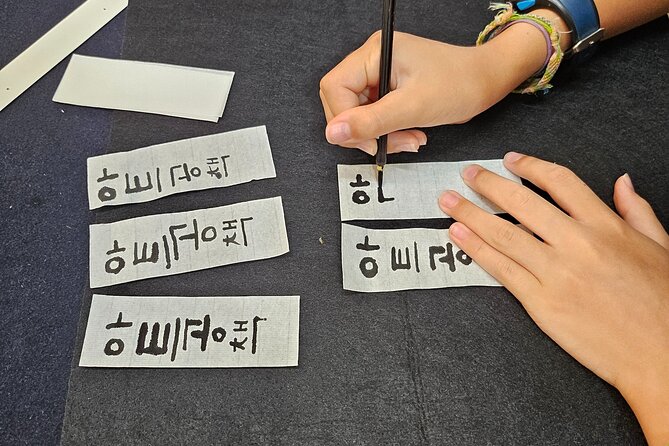
You’ll start by folding specially selected papers in a calm, careful way, then you’ll choose a thread color and build your notebook using a needle and thread binding method. A standout part is writing your name in Korean characters: you practice with a brush and then make a cover title piece that turns the whole thing from craft project into a travel keepsake.
I’d call this a strong value for the money because you’re paying for real craft time with an expert, not just a quick photo stop. It’s about 1 hour 30 minutes, and it ends back at the same meeting point, so it’s easy to plug into a day in central Seoul.
In This Review
- Key highlights you’ll care about
- Insadong bookbinding: why this location matters
- Tongmoongwan studio setup: what the start feels like
- Fold and arrange: building the pages the traditional way
- Traditional Korean binding: holes, needle, and thread
- Your thread color and the visual payoff
- Writing your Korean name: brush practice to a cover title
- Using your finished notebook for Seoul memories
- Price and time: is $39.89 worth it?
- Who should book this class (and who might not)
- Booking details you should plan around
- Book it or skip it: my practical call
- FAQ
- How long is the Korean notebook bookbinding class?
- Where does the class take place?
- What will I make during the workshop?
- Is it a small group experience?
- Do I need a reservation?
- What if I don’t know Korean calligraphy?
- How much does it cost?
- Can I cancel for a refund?
Key highlights you’ll care about
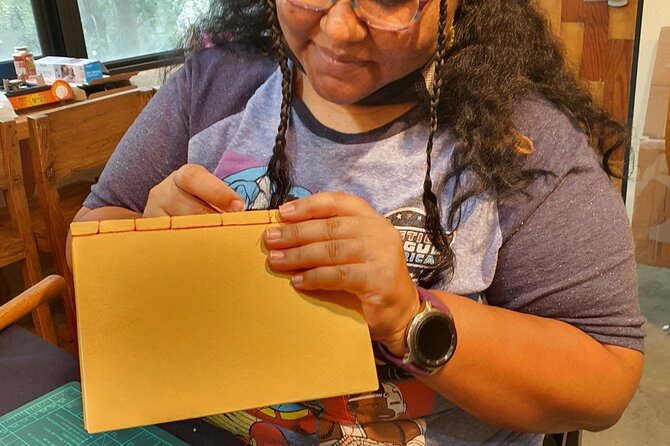
- Small group attention: you assemble and bind step by step, so you’re not left to guess.
- Traditional binding, not a shortcut: you make holes and secure the book with needle and thread.
- Your Korean name becomes the cover art: brush practice plus a title piece for a personal touch.
- Choose your own thread color: a small choice that changes the whole look of the notebook.
- Made for travel journaling: tickets, notes, and sketch moments fit naturally in the finished size.
- Insadong only: it’s a focused experience tied to the cultural center of Seoul.
Insadong bookbinding: why this location matters
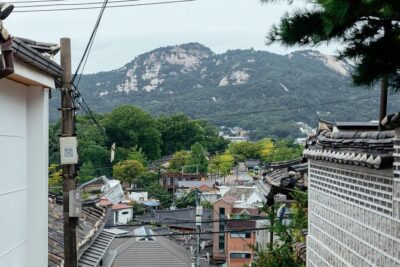
Insadong is one of those areas where Seoul feels like Seoul—old-school streets, craft shops, and a steady flow of visitors hunting for meaningful things. This class being only in Insadong isn’t just a convenience. It means you can make your afternoon feel cohesive: you’re already surrounded by Korean design and handmade goods, then you sit down and learn the process behind them.
Also, the meeting point is in a small studio setting on Insadong-gil (3rd floor). One review notes it’s near Gyeongbokgung Palace, which is helpful because it lets you plan the class alongside other major sights in the same side of town. In practice, that reduces friction. You’re not crossing half the city to find a workshop.
You can also read our reviews of more tours and experiences in Seoul.



Tongmoongwan studio setup: what the start feels like
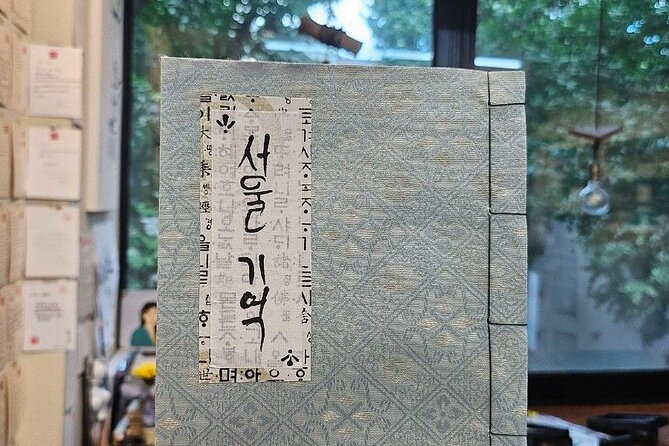
You meet at 3rd fl, 55-1 Insadong-gil, Jongno District. The activity ends back at the meeting point, so you’re not dealing with a long, wandering itinerary.
From the class flow, you should expect a relaxed pace and a “watch, do, repeat” rhythm. The workshop is described as small group with guidance from a Korean craft artist, and the reviews back up that the instructions are clear. That matters because bookbinding has a few steps where it helps to have someone point out what “precise” really means—especially when you’re making holes and tying everything together.
The studio setup also tends to make this an easy choice for a short date or a solo activity. One review calls it a cute quick date, which lines up with the vibe here: you’re not expected to be a calligraphy pro or an art student. You’re just expected to show up, follow directions, and take your time with the folding and stitching.
Fold and arrange: building the pages the traditional way
Here’s the core of what you’ll do, step by step.
First, you begin the meditative part: carefully folding specially selected papers. The goal isn’t speed—it’s accuracy. Folding is where a notebook starts deciding whether it will feel crisp and aligned later on. You’ll fold and prepare the pages before you assemble them between two elegant covers.
Then you move into the layout stage. You’ll choose your thread color early, which is a good move because the thread becomes part of your identity for the notebook. After that, you arrange 15 sheets between two covers. That’s enough pages to feel useful, but not so many that the workshop turns into a long, exhausting marathon.
This is one of the strongest reasons I think you’ll like the class. In a lot of “make something” activities, you mostly decorate. Here, you’re building the structure that makes the notebook work. You get a practical understanding of how paper becomes a bound object.
Traditional Korean binding: holes, needle, and thread
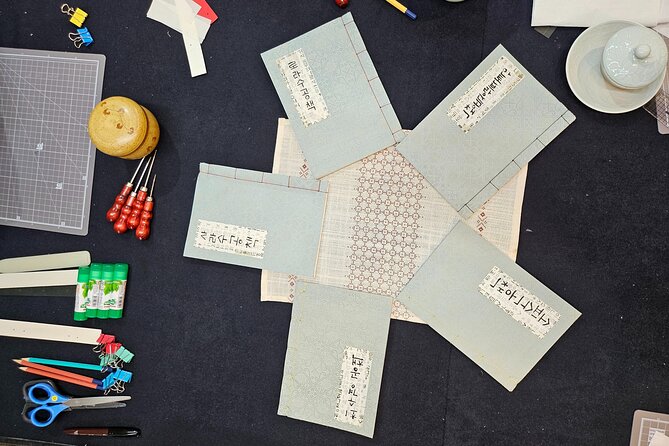
Next comes the binding technique—this is the part that turns your notebook from paper stack into an actual book.
You’ll learn to make precise holes and secure the notebook with needle and thread. This is the technique that preserves the traditional feel, and it’s also the step that makes the final product feel handmade rather than store-bought. Once you tie it off and see everything hold together, you’ll understand why Korean bookbinding is treated as craft, not just DIY.
Because the class is guided and described as step-by-step with personal attention, you’re not expected to magically know the right spacing or tension. The best-case scenario is that you can match what your craft artist shows you, then adjust when you’re tying and finishing. Clear instructions are a big theme in the feedback, and that makes a real difference here—needle-and-thread work rewards clarity.
Practical note: plan to take your time with the threadwork. If you rush, you’ll feel it later in alignment and neatness. The workshop length (about 1 hour 30 minutes) is tight enough to keep things moving, but long enough that careful work pays off.
Your thread color and the visual payoff
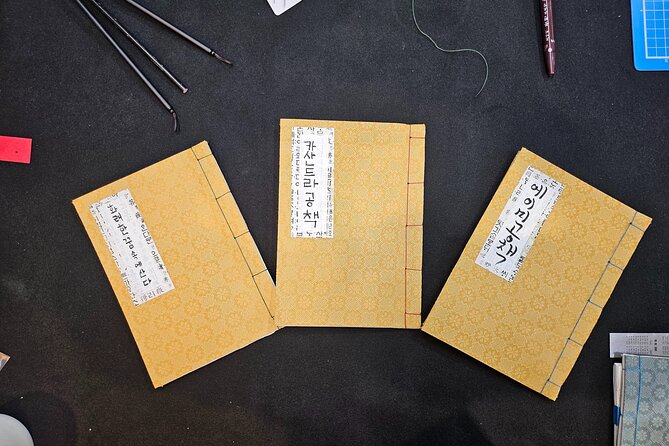
You get to pick your preferred thread color. That sounds like a small detail, but it’s one of the most visible parts of the notebook because the thread is part of the binding. It turns the notebook into something you can recognize as yours the moment you look at it.
If you like planning ahead, you can choose a color that matches your travel mood—classic black or warm tones for a restrained look, or something brighter if you want the notebook to feel cheerful and personal. Even though the workshop is focused on traditional technique, your thread color gives you freedom inside that structure.
This is also why the notebook makes such a satisfying souvenir. It’s not just “I did an activity.” It’s “I made a tool I’ll actually use.” The look and the function combine.


Writing your Korean name: brush practice to a cover title
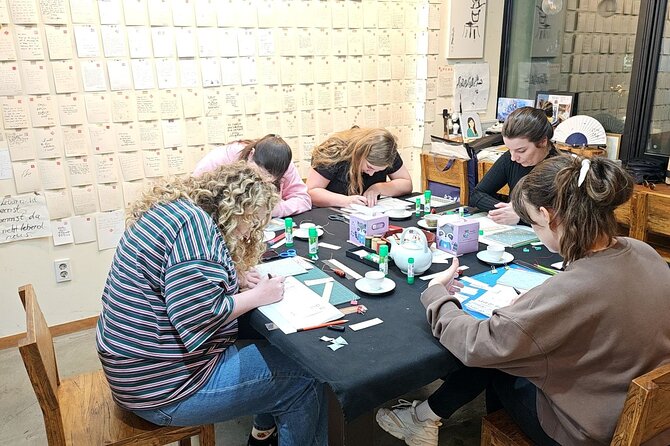
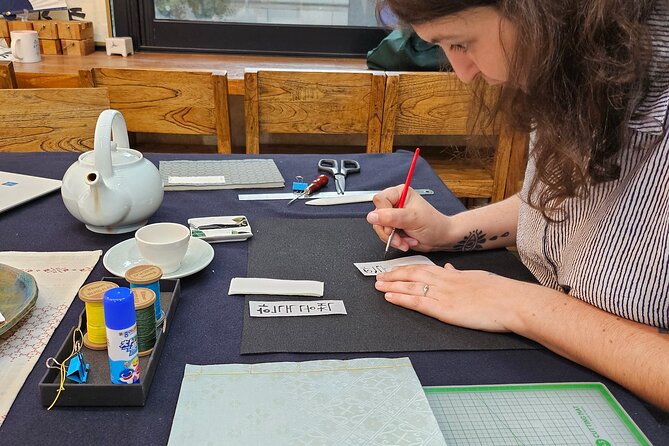
One of the most personal parts of this class is learning to write your name in Korean characters.
You’ll practice your Korean name with a brush first. That step matters because it’s not only about copying letters. It’s about getting confident with how Korean characters look and feel in brush form—how the strokes land and how the shapes connect. Even if your handwriting isn’t perfect, you’re learning the basic rhythm and getting guidance to improve.
Then you create a beautiful title piece to adorn the cover of your handmade notebook. This turns the notebook into a keepsake that feels earned. You’re not just writing on a cover with a pen; you’re preparing a title element designed to look like traditional craft work.
For me, this is the part that makes the notebook feel tied to your time in Seoul. It’s one thing to buy a souvenir with Korean text. It’s another to produce your own name-based design using a traditional practice style.
Using your finished notebook for Seoul memories
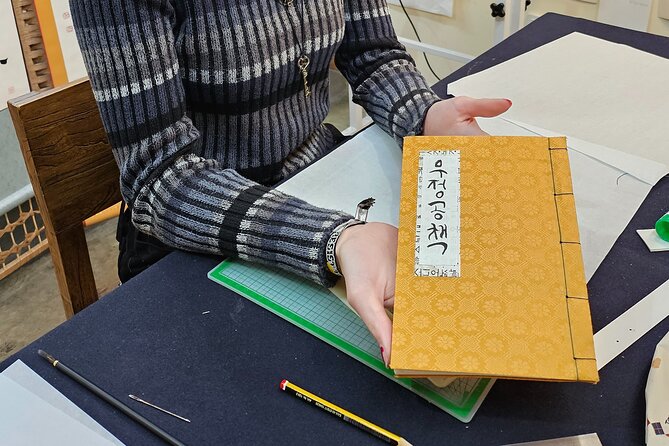
Once it’s done, you’ll have a notebook designed for travel use: storing tickets, writing travel memories, and even sketching scenes from your journey.
The “for travel” angle is more than marketing language. A binding like this tends to feel good in-hand, and the pages are built for actual note-taking rather than filling with a single decorative page. If you’re the type who keeps museum ticket stubs, cafe receipts, or short daily notes, you’ll find an instant use for it.
Also, the workshop ends back at the meeting point, which is helpful when you’re planning the rest of your day. You don’t have to carry a fragile craft through a long route before you can put it somewhere safe.
Price and time: is $39.89 worth it?
At $39.89 per person for about 1 hour 30 minutes, you’re paying for three things:
1) Instruction from a Korean craft artist (step-by-step coaching)
2) Materials and a finished handmade notebook that you assemble yourself
3) A cultural skill you’ll recognize again the next time you see Korean craft work
Compared to typical “activity souvenirs,” this feels practical. You’re not buying a small object off a shelf; you’re learning the structure and technique that creates the object. That’s why the class often hits well for couples and solo travelers—one is the shared experience, the other is the independence of making something that stays with you.
Could it be expensive if you only want a quick souvenir photo? Yes. If you want nothing more than a shop-bought gift, skip it. But if you enjoy hands-on culture, this price feels fair for what you leave with.
Who should book this class (and who might not)
This is a great fit if you:
- like hands-on crafts more than guided sightseeing
- want a personalized keepsake you can actually use
- enjoy calm, careful tasks like folding, arranging, and stitching
- want to practice Korean writing in a structured, supportive setting
It may be less ideal if you:
- hate close-handwork tasks (needles and tying thread can be fiddly)
- expect a big “tour” with multiple stops and lots of walking
- only want an inexpensive impulse activity with no commitment
One more practical factor: because it’s available only in Insadong and requires reservations, you should plan it like a real appointment, not a drop-in errand.
Booking details you should plan around
Workshops take place only in Insadong, and only guests with reservations can attend. You’ll receive confirmation at the time of booking, and you’ll have a mobile ticket.
The location is near public transportation, which helps if you’re hopping between major Seoul sights. And the workshop is described as small group with personal attention, with most travelers able to participate.
If you’re building a Seoul day itinerary, aim to schedule this when you’re not rushing to catch something right after. You’ll want enough mental space to focus on careful steps, and it’s nicer when your post-class plans don’t feel like a sprint.
Book it or skip it: my practical call
Book this if you want a meaningful, hands-on cultural memory that isn’t just a photo. The strongest reasons are the clear instruction, the small-group feel, and the fact that you create both the notebook structure and a personal cover title using your Korean name. It’s craft you can hold, use, and keep.
Skip it if you’re mainly shopping for bargain souvenirs or you’re short on time and hate detailed, careful tasks. This isn’t a “watch and leave” experience. You’re making choices (like thread color), doing the work (folding, hole-making, stitching), and finishing with your own calligraphy-based cover piece.
If that sounds like your kind of Seoul afternoon, this is an easy yes.
FAQ
How long is the Korean notebook bookbinding class?
The workshop is about 1 hour 30 minutes.
Where does the class take place?
It takes place only in Insadong, Seoul. The meeting point is 3rd fl, 55-1 Insadong-gil, Jongno District.
What will I make during the workshop?
You’ll make a traditional Korean notebook by folding specially selected papers, arranging 15 sheets between covers, and binding it with needle and thread. You’ll also personalize it with a Korean-name title piece for the cover.
Is it a small group experience?
Yes. The workshop is described as a small group with personal attention.
Do I need a reservation?
Yes. Only guests with reservations can attend, and workshops have limited availability.
What if I don’t know Korean calligraphy?
You’ll practice writing your Korean name using a brush as part of the class, so you’re not expected to already know calligraphy.
How much does it cost?
It costs $39.89 per person.
Can I cancel for a refund?
Yes. You can cancel for free up to 24 hours in advance of the experience’s start time for a full refund.