REVIEW · SEOUL
(Small Group) Palace & Seoul Old Town Highlights
Book on Viator →Operated by Honey Trail · Bookable on Viator
Seoul’s palace walls and old lanes fit in one walk. This Small Group Palace & Seoul Old Town Highlights tour strings together major Joseon-era landmarks and today’s central neighborhoods in about 3 hours. You’ll get a tight loop plan plus a guide who explains what you’re seeing as you move.
I especially like the small group size (max 10), because questions feel easy and you’re not just following a crowd. I also like that Gyeongbokgung Palace ticket is included, so you don’t waste time sorting admissions while you’re in the thick of the sights.
The main thing to consider is pacing: it’s a fast walking route across several key places, and time at each stop is limited. If you want to linger for long photo sessions or slow browsing in every alley, you might feel a little rushed.
In This Review
- Key things to know
- How this 3-hour Seoul highlights loop makes sense
- Price and what you truly get for $60.27
- Meeting at Anguk Station Exit 6 and staying on time
- Stop 1: Insadong for traditional goods, restaurants, and tea houses
- Stop 2: Jogyesa Temple, a calm break in the middle of the city
- Stop 3: Gwanghwamun Square in front of the palace zone
- Stop 4: Gyeongbokgung Palace with the included ticket
- Stop 5: Bukchon Hanok Village and the hanok alley feel
- Guide Lee’s approach: history with room for questions
- Walking pace and comfort: what to expect on your feet
- Who should book this tour (and who might want a longer one)
- Should you book the Palace & Seoul Old Town Highlights tour?
- FAQ
- What time is the tour, and how long does it last?
- Where does the tour start, and does it end nearby?
- How big is the group?
- Is admission included, or do I pay separately?
- What kind of ticket do I use for check-in?
- What happens if weather is bad?
Key things to know
- Max 10 people keeps the tour interactive and question-friendly
- Gyeongbokgung Palace ticket included saves time and adds value
- Insadong to Bukchon covers classic old-town Seoul in one compact route
- Jogyesa Temple adds a calm, spiritual pause without extra admission costs
- Lee’s style blends Joseon-era context with modern culture facts and fun mini breaks
- Mobile ticket makes check-in simple once you’re at the meeting point
How this 3-hour Seoul highlights loop makes sense
This tour is built for short trips. You get the big-name palace zone plus the nearby old-town neighborhoods, without trying to do everything solo across multiple subway lines. In practice, the route helps you get your bearings fast while learning what to look for next time you visit.
The timing is also smart. You’re not spending the entire day on one monument. Instead, you see how different parts of Seoul connect: religious Seoul (Jogyesa), royal Seoul (Gyeongbokgung and the surrounding square), and everyday traditional life (Insadong and Bukchon).
Because the group is capped at 10, the tour doesn’t feel like a moving lecture. You’re walking, stopping, and absorbing context in small chunks, which is perfect when you’re only in Seoul for a few days.
You can also read our reviews of more tours and experiences in Seoul.
Price and what you truly get for $60.27
At $60.27 per person, this isn’t a “cheap-only” deal, but it’s not inflated either. The key reason it holds value is that the Gyeongbokgung Palace admission is included. Everything else on the route is listed as free admission, so you’re mostly paying for guided time, coordination, and expert interpretation.
You’re also buying convenience. A 3-hour schedule with a set order means you spend less time figuring out where to go next and more time understanding what you’re seeing. If you’re the type who likes to know the meaning behind architecture and street layouts, a guided walking route can be worth more than it sounds.
One practical note: the itinerary includes multiple walks and short stops. That means you should budget energy like it’s a half-day on your feet, not a casual stroll where you can pause for long detours.
Meeting at Anguk Station Exit 6 and staying on time
The tour meets at Anguk Subway Station, Exit 6 (outside), and it returns you back to the same meeting point. That is a comfort factor. You don’t need to worry about ending somewhere inconvenient or figuring out your own route back at the end.
Arriving a few minutes early helps. Walking tours move best when everyone starts together, and this one is designed to hit several stops efficiently. The fact that you use a mobile ticket is helpful too; it reduces friction at check-in, especially on busy subway days.
In your planning, wear shoes you can walk in for stretches of time, because the route is stop-and-go across central areas. If you have mobility concerns, it’s a good idea to consider whether fast walking between stops will suit your pace, even though the tour notes it’s suitable for most people.
Stop 1: Insadong for traditional goods, restaurants, and tea houses
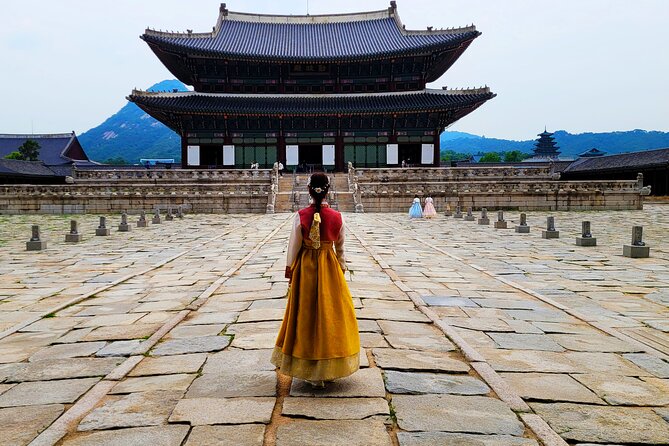
Insadong is where the tour gives you “street-level” Seoul. It’s known for traditional goods, restaurants, and tea houses, and that makes it a natural first stop because it sets the tone for what comes later. You’re not starting at a monument; you’re starting in a neighborhood where traditional and everyday life are tangled together.
With about 10 minutes here, you won’t cover every side street. Instead, treat this as an orientation stop. Look for the kinds of shops and textures that make Insadong feel distinct, then use what you learn as a guide for wandering on your own later.
If you’re curious about Korean crafts, teas, or the vibe of older commercial streets, this first touch helps you understand why Insadong is often listed as a must for Seoul’s traditional flavor.
Stop 2: Jogyesa Temple, a calm break in the middle of the city
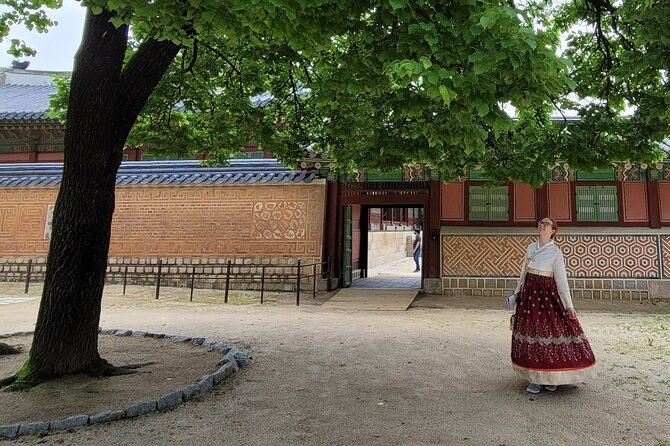
Next comes Jogyesa Temple, the head temple of the Jogye Order of Korean Buddhism. Founded in 1910, it’s described as a peaceful sanctuary in central Seoul, and that’s the point of this stop: you get a quiet mental reset before moving back into royal history.
This is also a free-admission pause with about 30 minutes. That length is long enough to slow your pace. You can notice how temple spaces create a different rhythm from the streets outside—less rushing, more stillness—without needing extra tickets or planning.
If you’re thinking about what to do in Seoul beyond palaces, this stop matters. It adds cultural depth without turning your day into a string of crowded photo points.


Stop 3: Gwanghwamun Square in front of the palace zone
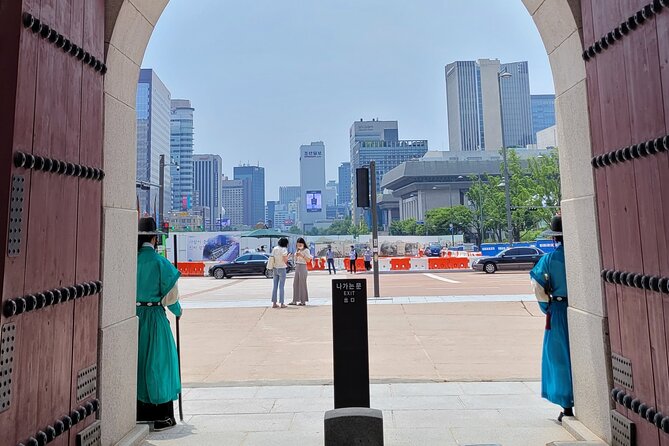
Gwanghwamun Square sits right at the center of things, located in front of Gyeongbokgung Palace. It features statues of King Sejong the Great and Admiral Yi Sun-sin, which makes it a quick but meaningful “history checkpoint.”
You’ll spend about 20 minutes here. Use this time to get your bearings: once you stand in this square, the palace area reads more clearly. The guide commentary helps connect the landmarks you see to the larger story of Korea’s past.
This stop is also useful for planning your photos. Even if you don’t spend long here, it gives you a sense of scale—this is a major ceremonial zone, not just a palace complex.
Stop 4: Gyeongbokgung Palace with the included ticket
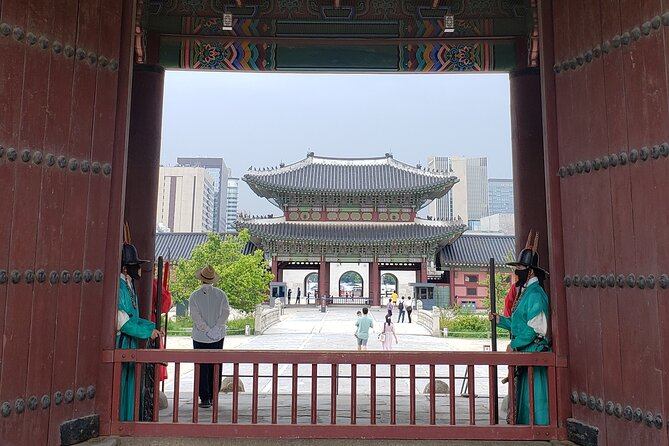
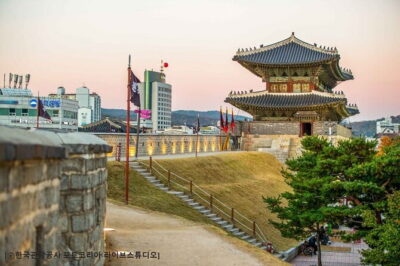
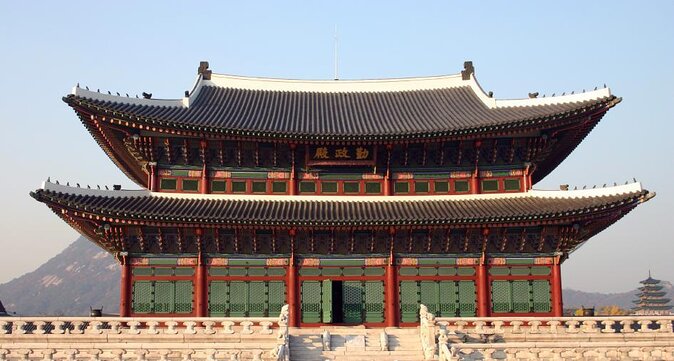
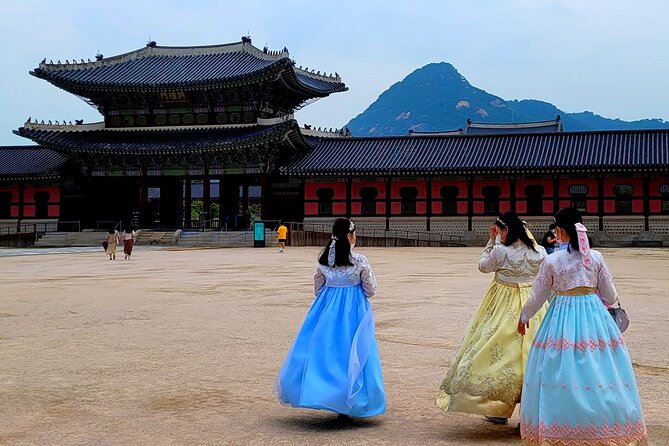
Gyeongbokgung Palace is the core of the tour, and it’s also where the included admission earns its keep. It’s described as the main royal palace of the Joseon Dynasty, built in 1395. The setting matters too: mountains behind and the city in front is part of how the space was designed and understood.
You’ll have about 1 hour 30 minutes inside, and that’s a solid chunk for seeing the palace’s layout without turning your afternoon into a marathon. Instead of trying to memorize everything, focus on how the architecture creates hierarchy and atmosphere—where you enter, where key buildings sit, and how the grounds frame royal life.
Because the ticket is included, you avoid the most annoying part of palace visits: waiting on entry details or last-minute payment. The guide’s role here becomes extra valuable, since you’re not just walking through stone and wood—you’re interpreting it.
Stop 5: Bukchon Hanok Village and the hanok alley feel
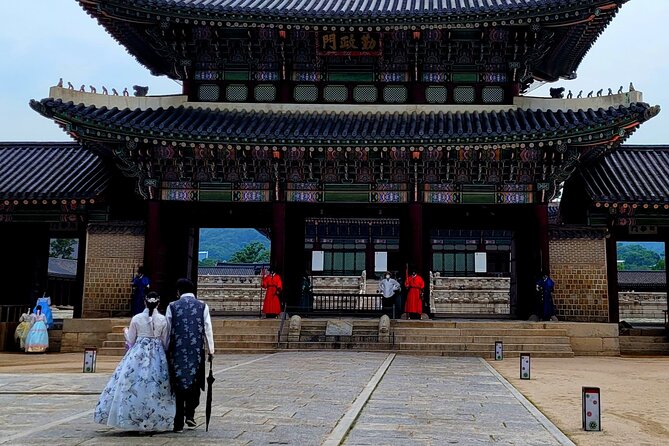
Bukchon Hanok Village is a historic neighborhood between two royal palaces, and it’s centered on traditional Korean houses called hanok. The point of stopping here after Gyeongbokgung is that you’re moving from state-level royal spaces to everyday historic living spaces nearby.
You’ll have about 30 minutes here, with free admission. This is enough time to experience the winding alleys and rooftops that show how people once lived during the Joseon Dynasty. It’s also enough time to pick up a few “I get it now” impressions, then save longer wandering for a return visit.
Be ready for uneven walking and narrow paths typical of old residential streets. If you like photography, this is a great zone to practice slow looking: notice the roof shapes, materials, and the way the village sits between palace landmarks.
Guide Lee’s approach: history with room for questions
A lot of the tour’s power comes down to the guide. This experience is associated with Honey Trail, and the guide’s name is Lee. What stands out in the way this tour is described is balance: Lee focuses on Joseon-era context while also adding facts about present-day Korean culture.
The other practical advantage is engagement. During breaks, Lee uses small touches like mini quizzes and traditional Korean games, which keep the energy up without turning the day into a gimmick. It’s especially helpful if you’re the kind of person who learns better by doing, not just listening.
Most importantly, Lee is patient and tuned to the group’s questions. In a half-day format, that matters. You don’t want to leave Seoul knowing only the facts the guide happened to plan; you want answers to the questions you actually care about.
Walking pace and comfort: what to expect on your feet
This is a walking tour that stacks multiple major neighborhoods into one route. That’s great for orientation, but it does mean there’s less downtime between stops than in longer tours.
Plan for:
- Comfortable shoes for uneven and busy areas
- A light layer for weather changes, since you’re outdoors for stretches
- A pace that allows you to stop, listen, and move again
The tour is positioned for most people, and service animals are allowed. Still, the format is most enjoyable when you’re okay with short bursts of sightseeing rather than slow, linger-everywhere wandering.
Who should book this tour (and who might want a longer one)
Book this if you want a high-impact introduction to Seoul’s palace and old-town DNA in one half-day. It’s a strong fit for first-time visitors, couples, friends, and anyone who likes walking with structure rather than wandering without a plan.
It’s also ideal if you care about context. The combination of royal spaces (Gyeongbokgung and the Gwanghwamun zone) and everyday historic streets (Insadong and Bukchon) makes the city feel connected instead of like separate tourist bubbles.
Skip it or consider a longer add-on if you prefer slow exploration. With limited time per stop, you’ll get great impressions but not the kind of deep, unhurried experience where you can spend hours inside a single palace complex or café-hop through every alley.
Should you book the Palace & Seoul Old Town Highlights tour?
If you’re trying to make the most of limited time, I think this is a smart choice. The included Gyeongbokgung Palace ticket, the short list of major stops, and the max-10 group setup add up to good value for your day.
If you’re on the fence, use this simple filter: do you want guidance and context while walking, or do you want to roam slowly on your own? If you want guidance, book it. If you want total freedom with no schedule pressure, you’ll probably prefer picking a couple areas and spending longer.
FAQ
What time is the tour, and how long does it last?
The tour duration is listed as about 3 hours.
Where does the tour start, and does it end nearby?
It starts at Anguk Station, Exit 6 (outside). The activity ends back at the same meeting point.
How big is the group?
The tour has a maximum of 10 travelers.
Is admission included, or do I pay separately?
The Gyeongbokgung Palace ticket is included. The other listed stops are marked as free admission.
What kind of ticket do I use for check-in?
You’ll receive a mobile ticket. Confirmation is received at booking time.
What happens if weather is bad?
This experience requires good weather. If it’s canceled due to poor weather, you’ll be offered a different date or a full refund. It can also be canceled if a minimum number of travelers isn’t met, with an alternative date/experience or a full refund.